
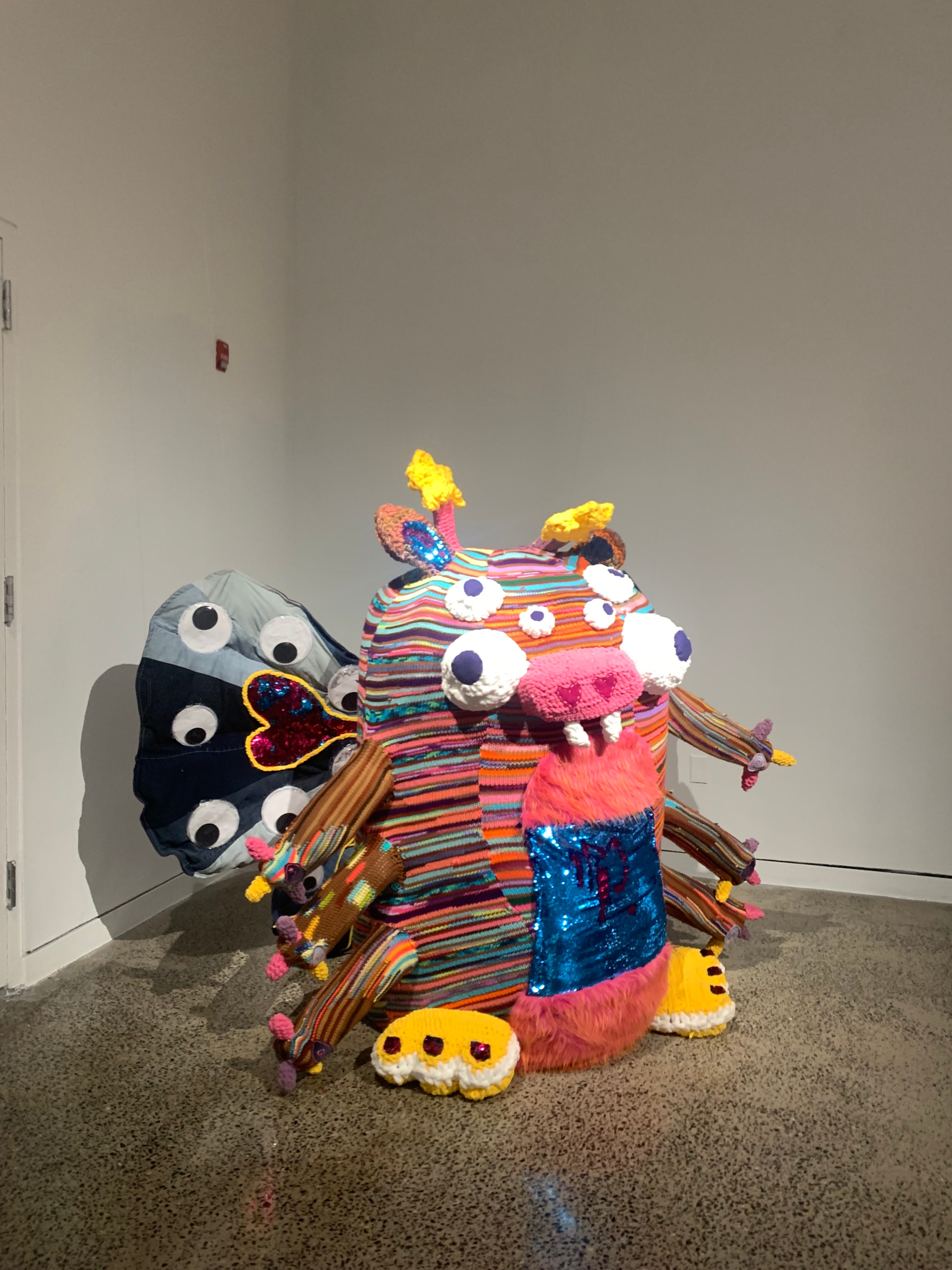
Reality is as you make it, but what if reality is a 6-eyed crochet monster?
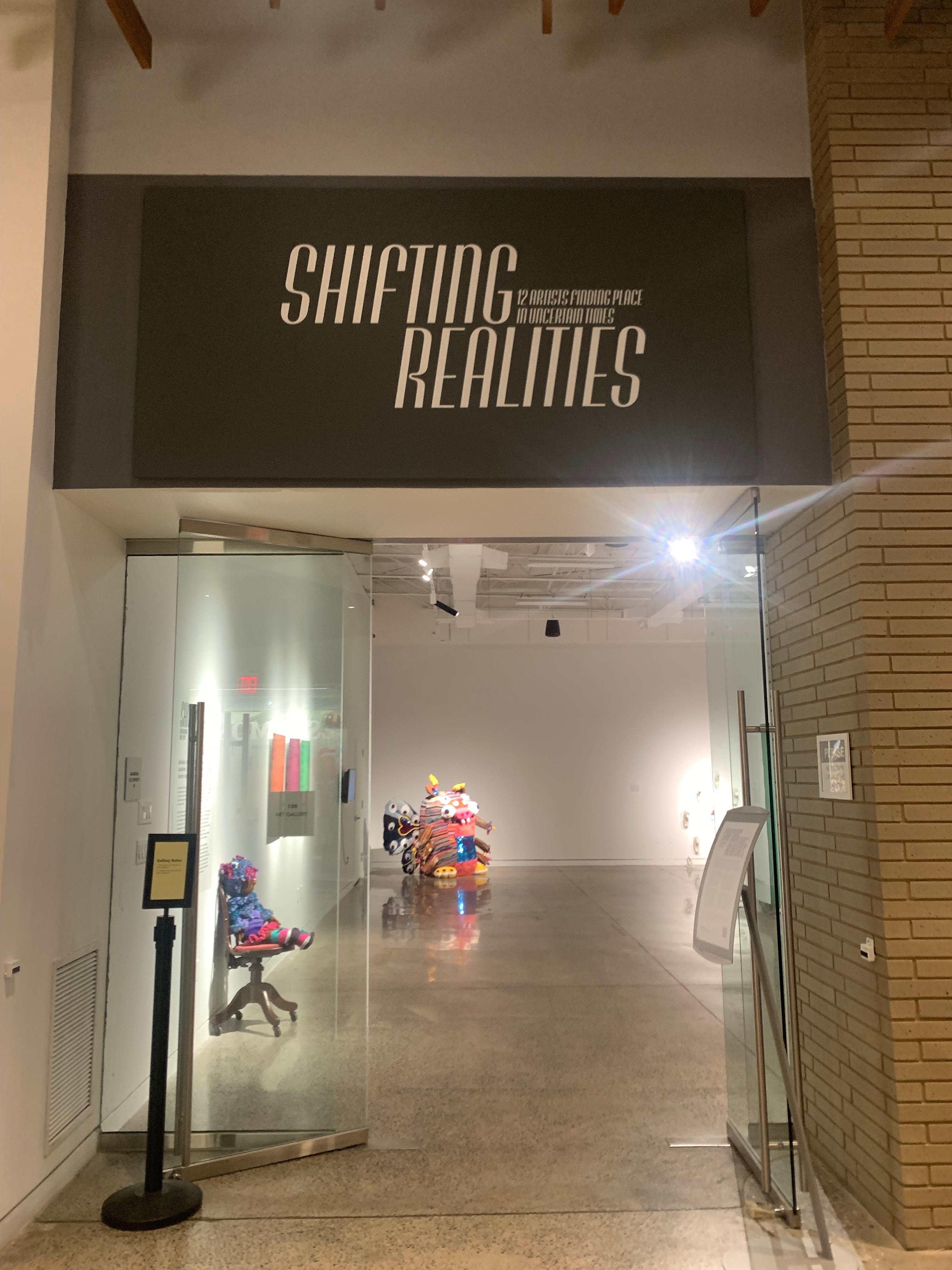
Shifting Realities: Artists Finding Place in Uncertain Times at Taller Puertoriqueño

It feels like a constant pummeling of headlines nowadays, especially as a first-generation American to Salvadoran parents. It’s like constantly holding my breath to prepare to read about mass deportations, scholars being kidnapped outside of their apartments by ICE, and Latin American countries being reduced to satellite mega prisons for Trump’s detainees. Chef and Writer Karla Vasquez aptly classified this feeling as “intellectual cultural vergazos.” Vasquez used this term to touch on the feeling of knowing that your home country is so much more than it is being presented as, but also not knowing where to get the truth. Vergazos is a word my family uses as punches or heavy tons. It’s the perfect hyperbole to illustrate the force of something, but I discovered that it can also mean “shame”. I assume many Latine families deal with the constant shifting of shame and pride, and it rolls with the tides of whichever current administration's stance is on immigration. When one doesn’t have the words to document and describe this feeling, there is always art.
The other day I rushed after work to visit Taller Puertoriqueño to catch the artist talk for Shifting Realities, a group exhibition highlighting artists whose practices confront today’s political polarization and uncertainty. After seeing the diverse names of artists participating in the exhibition, I was looking forward to the variety of voices and mediums being used to survey perspectives on “personal identity, reclaiming American icons, and defining communities in their spaces.”
I decided to take an unusual approach and attend an artist talk before viewing the exhibition firsthand. The panel consisted of 4 of the featured artists: Kukuli Velarde, Silvana Cardell, Marta Sánchez, and Eugenio Salas. The talk was very informal, where each artist chose to highlight a specific work and how it relates to the exhibition. This led to interesting discussions touching on the constant alienation of the immigrant experience and the nuances of language when referring to the contemporary Latine experience. From both the home country and host country, the act of relocating for security or family is a grinding force that impacts your perspective and calls attention to the stories of humans pressed to the margins of society.
The conversation was insightful but also heavy, and I felt the weight of the artist’s experiences and how it probably mirrors my own parents’ experience I walked towards the exhibition gallery. As if the curators assumed I needed comfort, they positioned the most joyfully unexpected pieces by the door. I was greeted by a charming doll made entirely of crochet fibers, and out of the corner of my eye I noticed a delightfully colorful beast lurking in the corner of the gallery. The work was made by Kalila Jones, presents as a smorgasbord of glittery yarn, technicolor patterns, and imaginative construction. Lil Kalila, a fully accessorized doll with a hat, cardigan, socks, shoes, earrings, and a glittery pair of glasses smiles on her perch in the front of the gallery, watching visitors as they take in the sights. Jones confidently steps into her role as an architect of her own reality with a one-of-a-kind creature with 6 arms, 6 eyes, butterfly wings, fangs, star antenna, all crocheted except for an inviting payette sequin fabric on it’s belly glimmering in the lights. Although these pieces are innocent and playful, I can’t deny the labor that went into each element. The concept of purposeful and intensive work leading to whimsical design stays in my brain for a while, and I wish I could have taken the pieces home with me.
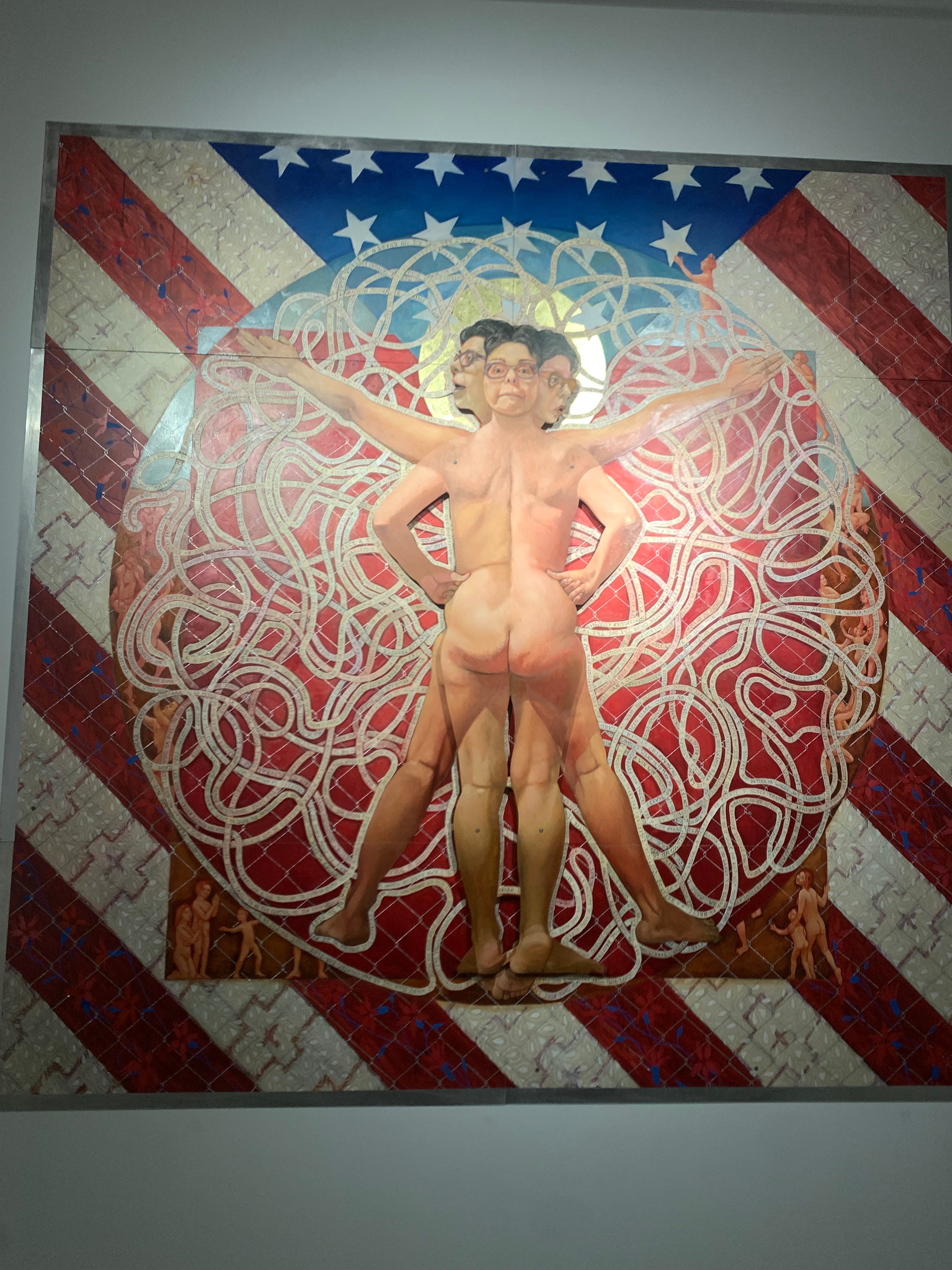
Other artists followed Jones’ lead for creating their own realities in a massive scale. Kukuli Velarde’s piece I Speak Spanish, Yo Hablo Inglés, is a larger painting on aluminum. Velarde presents herself as DaVinci’s Vitruvian Man, facing and reaching out in multiples directions as she spews her observations and frustrations with the fallacy of the American Dream, in both English and Spanish. The background imitates a skewed American flag, but upon closer inspection, visitors will notice it is made of chain link fence and crosses. Velarde forces visitors on a visual journey, craning our necks and leaning over to try to read all of her vulnerable thoughts. It almost feels intrusive, except the larger than life size of the figure presides over the gallery, inspiring reverence as visitors look up to meet Velarde’s gaze.
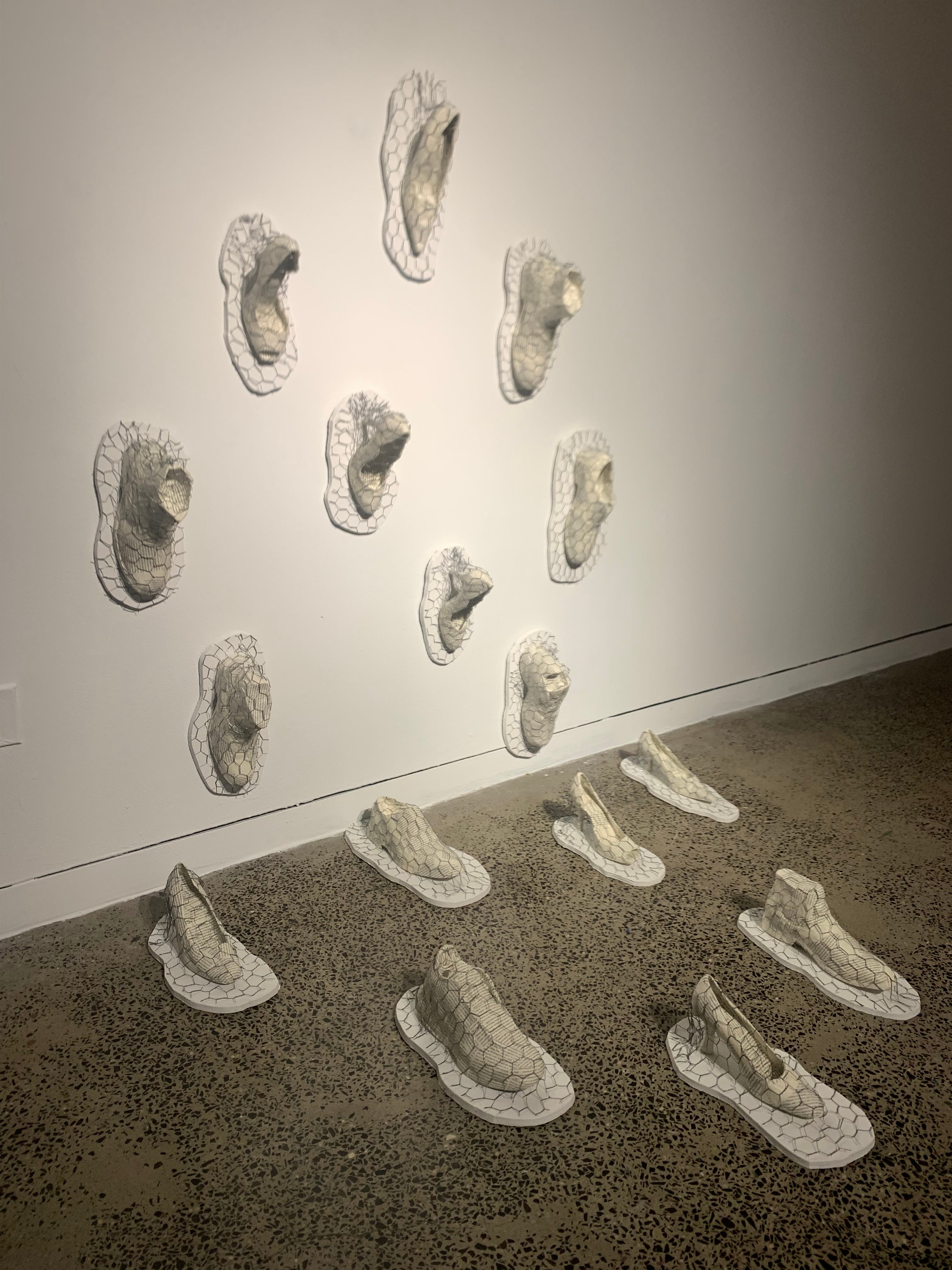
Although many pieces in the exhibition played with scale and fiery hues to communicate the blow of a shifting reality, I spent the most time looking at probably the most subtle work in the gallery. Mounted to the wall and leading to the floor was a gathering of single shoes whitewashed and encased in chicken wire. It was eerie seeing the boots, heels, or sneakers seemingly frozen and prevented from moving through time. Each shoe sits on top of a white base, like ripples showing the weight each object holds. When looking closer, I realized the whitewash comes from a layer of book pages pasted around and inside the shoes. Although the 16 shoes were presented together, there was a suggested loneliness that crept around the objects, separated from their partner and cemented in literature. The wall text of The Worn Path by Hagudeza Rullán-Fantauzzi stated the work was inspired by Clare Sears' book Arresting Dress, Cross-Dressing Law, and Fascination in Nineteenth-Century San Francisco, which explores the criminalization of people dressing outside of their assigned gender roles. With this context, I appreciated the simplicity of how Rullán-Fantauzzi presented her objects and yet represented the history of struggle and perseverance of the queer community as they shed the limitations of binary dressing. For San Francisco lawmakers of 1863 to assign sanctions to simple articles of clothing is absurd, but their efforts to use the law to constrict their constituents are disappointing and unjustified. Rullán-Fantauzzi’s work is a poetic operation that quietly reminds visitors that legislation is not always in line with morality, and the importance keep history in mind as its issues tend to come back again and again.
The introductory exhibition text referenced a quote by Gabriel Marquez Garcia, summarizing that reality is as you imagine it. Upon entering, I wondered if this was in reference to the American Dream, a living style that many folks from all around the world have sweated and labored for to come true. In the artist talk, Velarde mentioned that she never imagined the American Dream upon coming to the United States, and I believe her. Each artist is a storyteller of not only their experience in the U.S. but also the experiences of their communities. Viewing the exhibition will not give you a complete understanding of the immigrant experience, the queer experience, nor the minority experience, but it does suggest that all of these perspectives, real and imagined, are connected and under threat of the current times.
Shifting Realities: 12 Artists Finding Place in Uncertain Times featuring artists Kukuli Velarde, Henry Bermudez, Silvana Cardell, Hagudeza Rullán-Fantauzzi, Symone Salib, Linette Messina, Kalila Jones, Iliana Pagán-Teitelbaum, Miguel Antonio Horn, Marta Sánchez, Liliana Pérez and Eugenio Salas will be on display at Taller Puertoriqueño (2600 N. 5th Street, Philadelphia, PA 19133) through May 17, 2025. More information here.